 Grand Canyon Tours from Las Vegas
Las Vegas to Grand Canyon Drive: Distances, Drive Times and What You Pay on Arrival
The Las Vegas to Grand Canyon drive is the do-it-yourself alternative to a booked tour, and it works far better at one rim than the other. A routing engine puts Grand Canyon West about 122 miles and 3 hours 4 minutes from the Strip, and the South Rim about 276 miles and 5 hours 19 minutes away, with no stops. That gap decides the whole trip. This page covers both drives, the routes named in the routing data, the admission you pay on arrival, parking at both rims, the Arizona clock in winter, and the point where a coach day such as the ones compared on Grand Canyon tours from Las Vegas becomes the simpler choice.
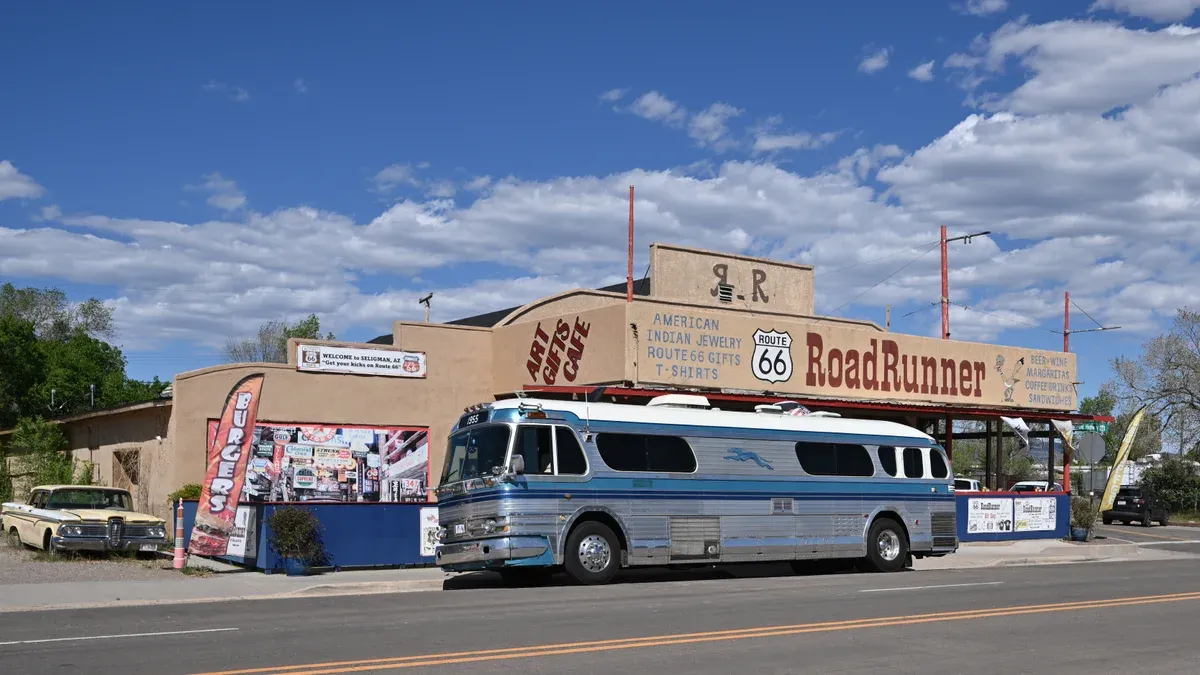
A vintage Greyhound bus sits parked outside the RoadRunner Cafe on Route 66 in Seligman. Photo: G. Edward Johnson, CC BY 4.0, via Wikimedia Commons
Quick answer Distances, arrival costs and the honest verdict
The Las Vegas to Grand Canyon drive covers about 122 miles to Grand Canyon West, around 3 hours 4 minutes each way, or about 276 miles to the South Rim, around 5 hours 19 minutes each way by road. A same-day South Rim drive means more than 10 hours of driving for a few hours at the rim. The West Rim works well as a day drive. Entry at Grand Canyon West costs $99 per person for the All-Access Pass, and the South Rim charges $35 per car.
Key takeaways
- Short on time? The West Rim is about 2 hours 15 minutes closer each way, and the West Rim bus day with a Hoover Dam stop at $94 removes the driving entirely.
- Set on the national park? The South Rim coach day with lunch at $124 does the 14-hour day without you touching a wheel.
- Comparing the two rims first? Read the West Rim vs South Rim breakdown before you pick a road.
- Passing the dam either way? See what a Hoover Dam stop adds to the route.
How Far Is the Grand Canyon from Las Vegas
Two different destinations carry the Grand Canyon name, and the distance to each differs by more than double.
The Two Distances
By road from the Las Vegas Strip, a routing engine gives Grand Canyon West about 122 miles and about 3 hours 4 minutes of driving, with no stops and no traffic. The South Rim at Grand Canyon Village is about 276 miles and about 5 hours 19 minutes. That makes the West Rim about 2 hours 15 minutes closer each way, which is why most same-day coach tours from Las Vegas go there. Hoover Dam sits about 34 miles and 51 minutes from the Strip, on the way to both rims.
The two rims are not the same place. Grand Canyon West is on the Hualapai Indian Reservation, owned and run by the Hualapai Tribe through the Grand Canyon Resort Corporation. National park passes such as America the Beautiful are not valid there. The South Rim, with Grand Canyon Village and Mather Point, is Grand Canyon National Park, run by the National Park Service. The full comparison lives on the West Rim vs South Rim page.
| Destination | Distance by road | Drive time, no stops |
|---|---|---|
| Grand Canyon West (West Rim) | about 122 miles | about 3 hours 4 minutes |
| South Rim (Grand Canyon Village) | about 276 miles | about 5 hours 19 minutes |
| Hoover Dam (on the way) | about 34 miles | about 51 minutes |
What the Raw Drive Time Ignores
The routing figures assume a nonstop run. In practice the tours add a Hoover Dam stop, a breakfast stop and rest stops, which is why West Rim coach days run 10-13 hours and South Rim days run 14-16 hours with about 3-4 hours at the rim. Driving yourself, budget the same way.
A 3-hour drive each way becomes a 10-hour day once you add two hours at the canyon, the $99 All-Access Pass paperwork at the Main Terminal, and the shuttle between viewpoints. A 5-hour 19-minute drive each way becomes a 13-hour day before you have seen anything, which is the honest number behind any same-day South Rim plan.
Sources: OSRM routing engine, Grand Canyon West
Driving from Las Vegas to Grand Canyon West
The closer drive, and the one that fits a single day from Las Vegas.
The Route and the Day
The drive to Grand Canyon West runs about 122 miles and 3 hours 4 minutes each way from the Strip. Most of the road to the West Rim passes through Arizona's Joshua Tree Forest, the same stretch the coach tours use, and Hoover Dam is about 51 minutes from Las Vegas on the way. Grand Canyon West is at 5001 E. Diamond Bar Road, Meadview, AZ 86444.
Timing matters because the gates are not open around the clock. Grand Canyon West opens at 8:00 a.m., takes its last entry at 4:30 p.m. and closes at 6:00 p.m., later in summer, and it is open every day of the year. A Sunset Pass gives entry after 3:00 p.m. with the Skywalk and the shuttle to Eagle Point and Guano Point, with last entry at 5:15 p.m. Work backwards from last entry when you leave Las Vegas. Note the winter clock too, covered below, because it can take an hour out of your afternoon without warning.
Admission and Parking on Arrival
Private cars park at the parking area by the Main Terminal. From there everyone moves by the free Hop-On, Hop-Off shuttle, which links the three stops: Eagle Point with the Skywalk and the Eagle Rock formation, Guano Point with open viewpoints and short trails at the old guano-mine tramway, and Hualapai Ranch. You cannot drive between viewpoints.
Admission is the Grand Canyon West All-Access Pass at $99 per person. It includes the Skywalk, the zipline, Hualapai guided tours and exhibits, performances, and the shuttle. Up to two children aged 5-12 enter free with one adult All-Access Pass at the Main Terminal. No separate $100 national park fee applies here, because this is tribal land and not the national park. Meals cost extra at restaurants at Eagle Point, Guano Point, Hualapai Ranch and the Main Terminal, though the pass gives a $10 discount with a minimum $20 food purchase per person at select spots. The Skywalk guide covers the glass bridge itself.
When the Drive Is Worth It and When It Is Not
Driving to the West Rim suits travellers who want control of the clock, who want the Sunset Pass afternoon, or who are continuing to Peach Springs, the Hualapai Reservation gateway town about 2 hours from Grand Canyon West. It costs less than most tours for a solo driver but not for a family of four paying $99 each, which is $396 at the gate.
For anyone who would rather not drive 6-plus hours round trip, the coach days undercut the math. The West Rim tour with a Hoover Dam stop and Wi-Fi costs $94 with hotel pickup and 3.5 hours at the canyon. The small-group Skywalk day at $205 for up to 12 people already includes the Skywalk pass, which on your own drive would sit inside the $99 gate ticket. On most other coach days the Skywalk is a paid extra chosen at booking.
Sources: Grand Canyon West FAQs
The 11 Best Stops on a Las Vegas to The Grand Canyon Road Trip
Stops along the drive from Las Vegas toward the canyon. Third-party video by Sidetrack Adventures. We did not shoot it and have no relationship with the creator.
Driving from Las Vegas to the South Rim
The national park drive, and the one where same-day returns stop making sense.
The Distance Problem
The South Rim at Grand Canyon Village is about 276 miles and 5 hours 19 minutes from the Strip each way, so the round trip is more than 10 hours of driving before a single viewpoint. Add time at Mather Point, Grand Canyon Village and the scenic routes the NPS lists west to east as Hermit Road, the Village and Desert View Drive out to Desert View, and a same-day drive becomes a 13-hour-plus day. The park itself is open 24 hours a day, 365 days a year, so night driving is possible, but some facilities close in winter even though the rim stays accessible.
The sensible self-drive pattern is to stay over. The NPS directions page gives the last stretch as about 60 minutes from Williams, Arizona, or about 90 minutes from Flagstaff, both on Interstate 40, with the South Entrance 6 miles north of Tusayan. Driving in from Las Vegas, sleep in Tusayan or the Village and take the rim at your own pace the next morning.
Entry Fees at the South Rim
The South Rim entrance costs $35 per private vehicle, $30 per motorcycle or $20 per person on foot or bicycle, valid for 7 days, with children under 16 free. From January 1, 2026, non-US residents aged 16 and over pay an extra $100 per person on top of that, waivable with a Non-Resident Annual Pass at $250 that covers up to 4 adults. This fee applies at the national park only, never at Grand Canyon West.
Parking is available around Grand Canyon Village and the inbound corridors, and the park runs free shuttles on the rim, so you park once and ride. The South Rim sits at about 7,000 ft (2,134 m), where the NPS warns walking can be strenuous, and summer highs generally reach the 80s Fahrenheit (27 to 32C) while winter lows sit in the teens Fahrenheit with 50 to over 100 inches (1.3 to 2.5 m) of snow a year.
If You Would Rather Not Drive It
A coach makes the 14-hour South Rim day survivable, and it sidesteps the fee confusion. The South Rim day with lunch and Wi-Fi at $124 includes the standard park entrance but not the $100 nonresident fee, which non-US residents pay as $100 per adult or the $250 Non-Resident America the Beautiful Pass. The South Rim bus with a dedicated guide at $177 collects the $100 in destination rather than at booking.
For a fuller trip, the two-day Grand Canyon, Antelope, Horseshoe Bend and Zion tour at $399.99 spreads the drive across two days with a hotel night in Arizona.
Sources: NPS fees, NPS basic info
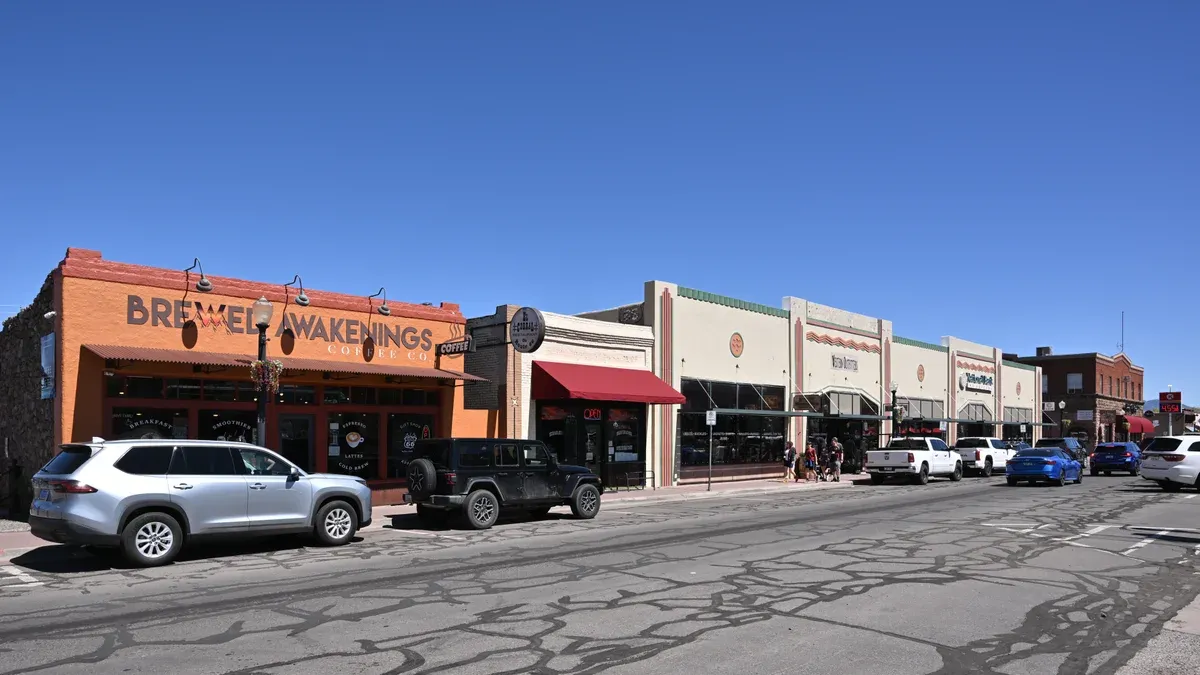
Route 66 storefronts line the main street through downtown Williams, the old gateway town to the canyon. Photo: G. Edward Johnson, CC BY 4.0, via Wikimedia Commons
What the Drive Actually Costs
Gate prices and road costs, drawn from the operators and agencies that publish them, next to what the cheapest booked days cost.
The Numbers Side by Side
The table below compares what you pay to arrive at each rim in your own car with what a booked day costs per person. Drive costs beyond fuel are not stated by the sources here, so the table lists only published fees. Two figures dominate: the $99 Grand Canyon West All-Access Pass per person, and the $35 South Rim vehicle fee plus the extra $100 per non-US resident aged 16 and over from 2026.
A family of four non-US residents pays $396 at the West Rim gate, or $35 at the South Rim vehicle gate plus $400 in nonresident fees, before fuel.
| Option | Published arrival costs | Drive each way | Notes |
|---|---|---|---|
| Drive to Grand Canyon West | All-Access Pass $99 per person, two children 5-12 free per adult pass | about 3 hours 4 minutes | No national park fee, no per-car charge published |
| Drive to the South Rim | $35 per car for 7 days, plus $100 per non-US resident 16+ from 2026 | about 5 hours 19 minutes | Same-day return means 10.5+ hours of driving |
| Coach day to the West Rim | from $94 per person | driven for you | Skywalk, lunch and gratuities are extra on the base fare |
| Coach day to the South Rim | from $124 per person | driven for you | Standard entrance included, nonresident fee not |
| Helicopter landing day | from $505.25 to $529 per person | by air | Lands below the rim at the West Rim only |
Extras That Catch Self-Drivers Out
At Grand Canyon West, meals are not in the $99 pass, and outside food and drinks are not allowed at the dining locations. The Skywalk itself bans cameras, purses and backpacks, which go in free lockers at the entrance, and phones are carried at your own risk. At the South Rim, the $100 nonresident fee is the single biggest surprise, and it lands per person, not per car.
Hoover Dam sits on either route. Walking across the dam is free from 5 a.m. to 9 p.m., the garage on the Nevada side costs $10 per vehicle, and the Bureau of Reclamation sells a self-guided Visitor Center ticket at $15, a Power Plant Tour at $25 for adults, and a full Dam Tour at $40 sold on site only, first come first served, which routinely sells out. The details are on the Hoover Dam stop page.
Data checked against the published operator and agency pages. Sources: Grand Canyon West, NPS fees, Bureau of Reclamation
Hoover Dam, Stops and the Arizona Clock
Three practical things that change the day: the dam stop, the stops the tours use, and the time zone.
Hoover Dam on the Way
Hoover Dam sits on the Nevada-Arizona line on the Colorado River, about 34 miles and 51 minutes from the Strip, so it fits either drive. Self-drivers cross the Mike O'Callaghan-Pat Tillman Memorial Bridge on US-93, which opened in 2010 and replaced the old hairpin route over the top of the dam. Every visitor to the dam passes a metal detector, weapons and knives are prohibited, and sealed food and drinks are allowed but cannot be eaten inside any building.
One line of advice is enough here, and the full treatment is on the Hoover Dam stop page.
Stops Worth Making
The road to the West Rim runs through Arizona's Joshua Tree Forest, and the coach operators treat it as a feature: the small-group Skywalk day adds a guided walk there plus a photo stop at the Welcome to Fabulous Las Vegas sign, and the National Park Express West Rim day stops at Hemenway Park in Boulder City, known for its bighorn sheep. Comedy on Deck and Sweetours include a breakfast stop on their West Rim days. The South Rim route climbs about 5,000 feet from the desert into pine forest, which is why rim temperatures run far below Las Vegas.
The Arizona Clock in Winter
Arizona stays on Mountain Standard Time all year and does not use daylight saving, while Las Vegas is on Pacific time. From March to early November the Grand Canyon clock matches Las Vegas at both rims. From early November to March, Arizona is one hour ahead, so a 4:30 p.m. last entry at Grand Canyon West arrives an hour sooner on your watch than the map suggests.
Plan winter returns against Arizona time, not Nevada time. This rule is the reverse of Antelope Canyon, which follows Navajo time.
Sources: Grand Canyon West FAQs, Bureau of Reclamation
Drive or Book: Which Fits Your Day
A short decision list, based on distances, gate prices and the published tour formats.
If You want a canyon day trip from Las Vegas and can drive
Drive to Grand Canyon West, about 122 miles and 3 hours 4 minutes each way, and buy the $99 All-Access Pass at the Main Terminal. Leave early enough for the 4:30 p.m. last entry.
If You want the actual national park in one day
Be honest about 10.5 hours of driving round trip. If that is too much, the South Rim coach day with lunch at $124 does it with hotel pickup.
If You are a non-US resident group of three or more
Do the math both ways: $99 each at Grand Canyon West with no nonresident fee, or $35 per car plus $100 per adult 16+ at the South Rim. A West Rim bus day at $94 can undercut self-driving for a family once fuel and a full day's driving are counted.
If You want below-the-rim but not behind a wheel at all
A helicopter landing tour is the answer, because federal flight rules keep landings out of the national park. The Papillon landing day with hotel transfer at $529 runs 4.5 hours door to door and lands 3,200-3,500 feet below the rim.
If You would rather see the canyon from the air than drive anywhere
Read the Grand Canyon helicopter tours from Las Vegas guide before booking, since terminal check-ins and weight rules differ by operator.
Las Vegas to Grand Canyon Drive: Questions
Is it worth driving from Las Vegas to the Grand Canyon?
It is worth it at the West Rim, which sits about 122 miles and 3 hours 4 minutes away, so the whole day stays manageable. At the South Rim the round trip is more than 10 hours of driving, which is where a coach such as the South Rim day with lunch and Wi-Fi becomes the better use of the day.
Can I do a day trip to the Grand Canyon from Las Vegas by car?
Yes, to Grand Canyon West. Gates open 8:00 a.m., last entry is 4:30 p.m. and closing is 6:00 p.m., later in summer, so an early start gives several hours at Eagle Point, Guano Point and Hualapai Ranch on the free shuttle. A same-day South Rim drive is possible but costs over 10 hours on the road, as the is a Grand Canyon day trip from Las Vegas worth it page explains.
Which part of the Grand Canyon is closest to Las Vegas?
Grand Canyon West, the West Rim, is closest at about 122 miles and about 3 hours 4 minutes of driving, against about 276 miles and 5 hours 19 minutes to the South Rim. Remember it is Hualapai tribal land, not the national park, a distinction set out in the West Rim vs South Rim comparison.
What is there to do between Las Vegas and the Grand Canyon?
Hoover Dam is about 34 miles and 51 minutes from the Strip on either route, with a $10 parking garage, a $15 self-guided Visitor Center ticket and a $40 full Dam Tour sold on site only. The West Rim road also passes Arizona's Joshua Tree Forest, and Boulder City's Hemenway Park is known for bighorn sheep. More detail is on the Hoover Dam stop page.
How much does it cost to drive to the Grand Canyon from Las Vegas?
At Grand Canyon West the All-Access Pass is $99 per person, with up to two children aged 5-12 free per adult pass, and no national park fee. At the South Rim it is $35 per car for 7 days, plus an extra $100 per non-US resident aged 16 and over from January 1, 2026. The full comparison sits in the costs section of this page and on Grand Canyon tours from Las Vegas.
Does the time change between Las Vegas and the Grand Canyon?
Only in winter. Arizona stays on Mountain Standard Time all year, so from March to early November the Grand Canyon matches Las Vegas, and from early November to March Arizona runs one hour ahead. That applies at both rims, and it is the reverse of Antelope Canyon on Navajo time, a note that matters on the sunrise, Antelope Canyon and Horseshoe Bend day.
Can a helicopter land at the bottom of the Grand Canyon on a Las Vegas trip?
Only at the West Rim. Federal flight rules over Grand Canyon National Park close most of it to low flights, so landing helicopters fly to Hualapai land, where Grand Canyon West says it is the only place a helicopter can land at the canyon floor. The Maverick deluxe landing tour at $505.25 lands 3,500 feet below the rim on a private bluff in 2.5 hours.